Old Age ̶D̶i̶s̶e̶a̶s̶e
I have written about this many times because this issue concerns me endlessly. And here it is again, “never happened before, and again.” Yesterday at the hotel, I danced. I danced quite a lot and enjoyed it immensely. But in the morning, upon waking, I felt a slight but noticeable pain in my knees and lower back. If I didn’t have the habit of carefully monitoring the processes occurring in my body (and for me, this is not only about health care but also a testing ground for developing therapeutic methods), I might have thought: it’s normal, I’m 55 years old, the activity was unusual, a little pain is natural.
But I analyze the situation and understand that this is not just muscle soreness, not the typical delayed onset muscle soreness after physical exertion. Although even that would have alerted me, because it would mean my daily activity is insufficient. But no, that’s not the case. This is pain in specific points in the knees and lower back. This tells me it’s time to pay more attention to strengthening the thigh and core muscles. Starting today, I am making adjustments to my training routine.
What worries me more is this. A “typical” 55-year-old woman waking up after unusual physical activity with unpleasant sensations in her body might decide this is just a normal part of aging and do nothing about it.
The condition I identified in myself today: weak thigh muscles and instability in the knee joints — in 5–7 years, this could lead to the need for joint replacement surgery.
Today, many treat such surgeries almost like Botox or hyaluronic acid injections, as if it’s a routine medical procedure to improve quality of life in mature age. But it’s not.
Joint replacement is not simply “repairing” a worn-out part. An artificial joint, even the most advanced, never exactly replicates the mechanics of the natural one. The movement pattern changes, the usual sequence of muscle activation during walking, standing, sitting shifts. The axis of movement, the sense of balance, the load angle on the spine all change. Along with the knee or hip joint, the entire kinetic chain “shifts”: the foot, pelvis, lower back, neck.
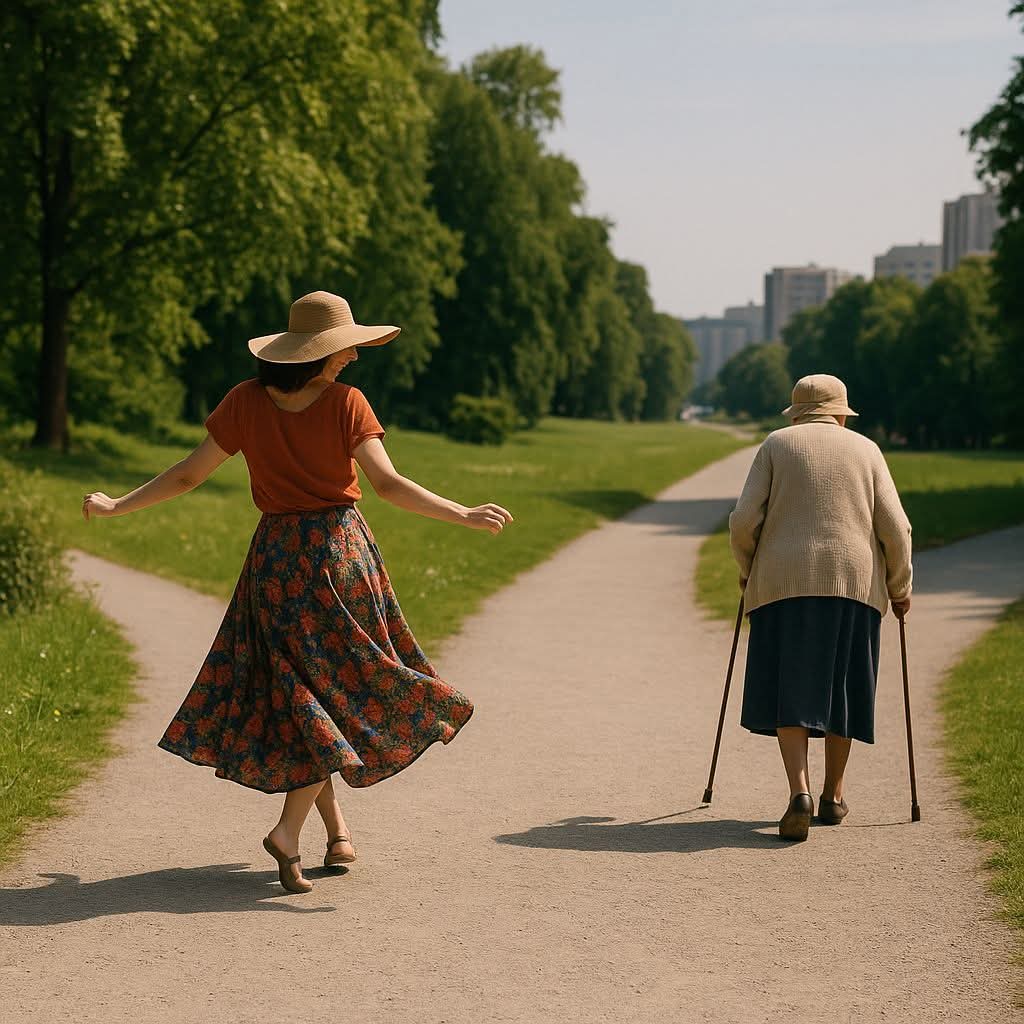
And so, from one point, from a pleasant evening of dancing, two different scenarios emerge.
One person wakes up with the decision to make changes to their daily training routine, strengthen muscles, and improve their health and quality of life.
Another, with the same bodily sensations, decides that “it’s all just aging” and steps onto the path leading to joint replacement surgery.
This cannot but concern me. I really want my posts, my texts, and all the information I provide to awaken people’s attention to their bodies, increase their level of awareness, self-observation, and sensitivity to themselves.
To foster the understanding that illness and weakness are not inevitable conditions of aging. Old age can and should be healthy, active, and joyful.