The beach as a physiotherapy room
Pain Medicine · Popular Science
The beach as a physiotherapy room
The beach brings together in one place several physical factors, each of which is used separately in physiotherapy: dry heat, an unstable surface, and an aquatic environment with its buoyancy and its resistance. None of these factors is exotic, all of them are well described, and each can be used deliberately rather than on the principle of “lay down, swam, went home.”
What follows is a breakdown by factor: what happens in the tissues, what the evidence supports, where the limits are and where the risks are.
01Warm sand: psammotherapy
Psammotherapy (from the Greek psammos, sand) is treatment with heated sand. The method is old, and it is still in use in balneological centres.
The physics. Dry sand conducts heat more slowly than water at the same temperature. Heat transfer is therefore gentler and more evenly distributed, and the body tolerates a sand wrap for longer than a hot bath of comparable temperature. This is what makes sand a convenient carrier of local heat.
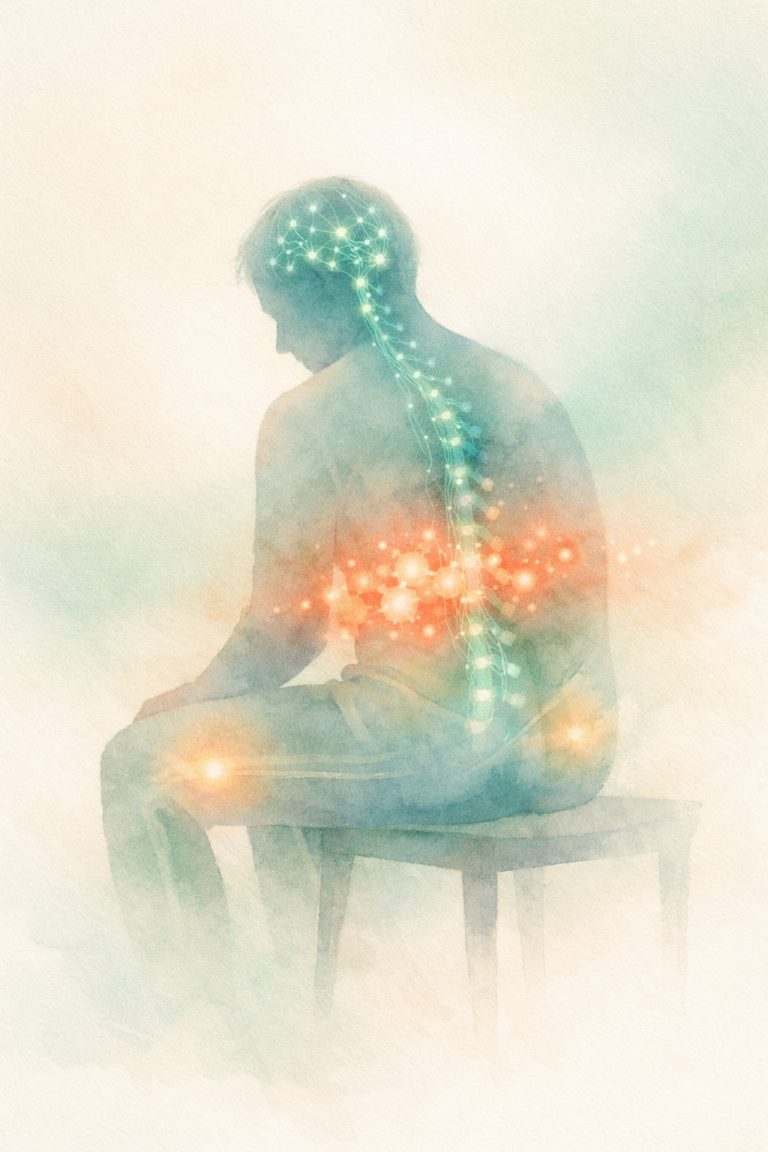
What heat does to tissue. Local warming causes vasodilation and increased blood flow in the underlying tissues. Connective tissue collagen becomes more pliable when heated, meaning the extensibility of fascia and capsules temporarily increases. At the same time, the sensitivity of the muscle spindles and gamma activity decrease, and muscle tone falls. In addition, thermal afferent input competes with pain input at the level of the dorsal horn of the spinal cord, which produces a brief analgesic (pain-relieving) effect.
Burying in sand as a weighted blanket. A separate and underrated effect. A layer of sand applies even pressure over a large area of the body. This is the same principle as weighted blankets: deep proprioceptive stimulation. The proposed mechanism is a shift of autonomic balance towards parasympathetic activity and a reduction in sympathetic arousal. Clinical data in this area still come mainly from the fields of sleep and anxiety: a randomised controlled study in the Journal of Clinical Sleep Medicine (2020) showed a significant reduction in insomnia severity with the use of a weighted blanket.
For a person with chronic pain and high baseline muscle tone, the combination of “even pressure, warmth and a horizontal position” works as a relaxation tool and as a way to reduce the tonic component of pain.
Safety rules
- Do not cover the chest with a thick layer: sand restricts respiratory excursion.
- 15–20 minutes is enough, head in the shade, water within reach.
- The surface layer of sand can be considerably hotter than sand at a depth of 10 cm. Check with the back of the hand.
- Caution in heart failure, uncontrolled hypertension and pregnancy.
- Diabetic polyneuropathy is a direct contraindication to hot sand and to walking barefoot on a scorching beach: temperature sensation is reduced and the burn will not be felt.
02Walking and running on sand
The classic work by Lejeune, Willems and Heglund (Journal of Experimental Biology, 1998) showed that walking on sand requires 2.1 to 2.7 times more energy than walking on a hard surface at the same speed, and running roughly 1.6 times more. Other studies give more modest figures, from 1.34 to 1.8 times. The spread has a simple explanation: the density and moisture of sand differ everywhere.
The reason is that part of the work goes into deforming the ground and is not returned. The elastic recoil of the tendons, on which the economy of ordinary walking depends, works less well on sand.
Distal work
Intrinsic foot muscles, toe flexors, ankle stabilisers, triceps surae, knee stability and balance.
Proximal work
Hips, gluteal muscles, trunk. Gait mechanics are close to normal, a long stride and speed can be maintained.
Loose dry sand: distal work. The foot sinks and every step demands stabilisation. The intrinsic foot muscles, the toe flexors, the ankle stabilisers and the triceps surae are all loaded. The knee is forced to work continuously on stability, and the balance system operates without pause.
A comparison of beach volleyball players with indoor players (Journal of Bodywork and Movement Therapies, 2024) showed that the beach players had significantly higher plantar surface sensation, greater dorsiflexion strength and greater toe grip strength, with a dominance of the intrinsic foot muscles. Barefoot work on an unstable surface produces both a sensory and a strength effect.
The other side: the Achilles tendon and the plantar fascia receive more dorsiflexion and more eccentric load. In Achilles tendinopathy (pain in the region of the Achilles tendon) or plantar fasciitis, start with 10 minutes.
Firm wet sand: proximal work. At the water’s edge the sand is packed, gait mechanics are close to normal, and a long stride and speed can be maintained. The work shifts upward: hips, gluteal muscles, trunk.
There is a catch here that works in our favour. A beach has a transverse slope. Walking along the water, one leg is functionally longer than the other, one foot pronates more, and the pelvis is carried at a tilt. For a person with healthy joints this is adaptation training. For a person with knee osteoarthritis, hip osteoarthritis or sacroiliac joint dysfunction it is a one-sided overload. The solution is simple: walk the same distance out and back.
Walking in water.
- Water below the knee: resistance acts on the shin, the knee and hip are working, and body weight is still almost fully loaded.
- Water above the knee, to mid-thigh or to the waist: the hips and trunk join in, and axial loading drops noticeably.
Water resistance increases roughly in proportion to the square of speed. This means the intensity of the session is controlled by pace alone, with no equipment at all. Waves and an uneven bottom add work for the balance system.
03Swimming
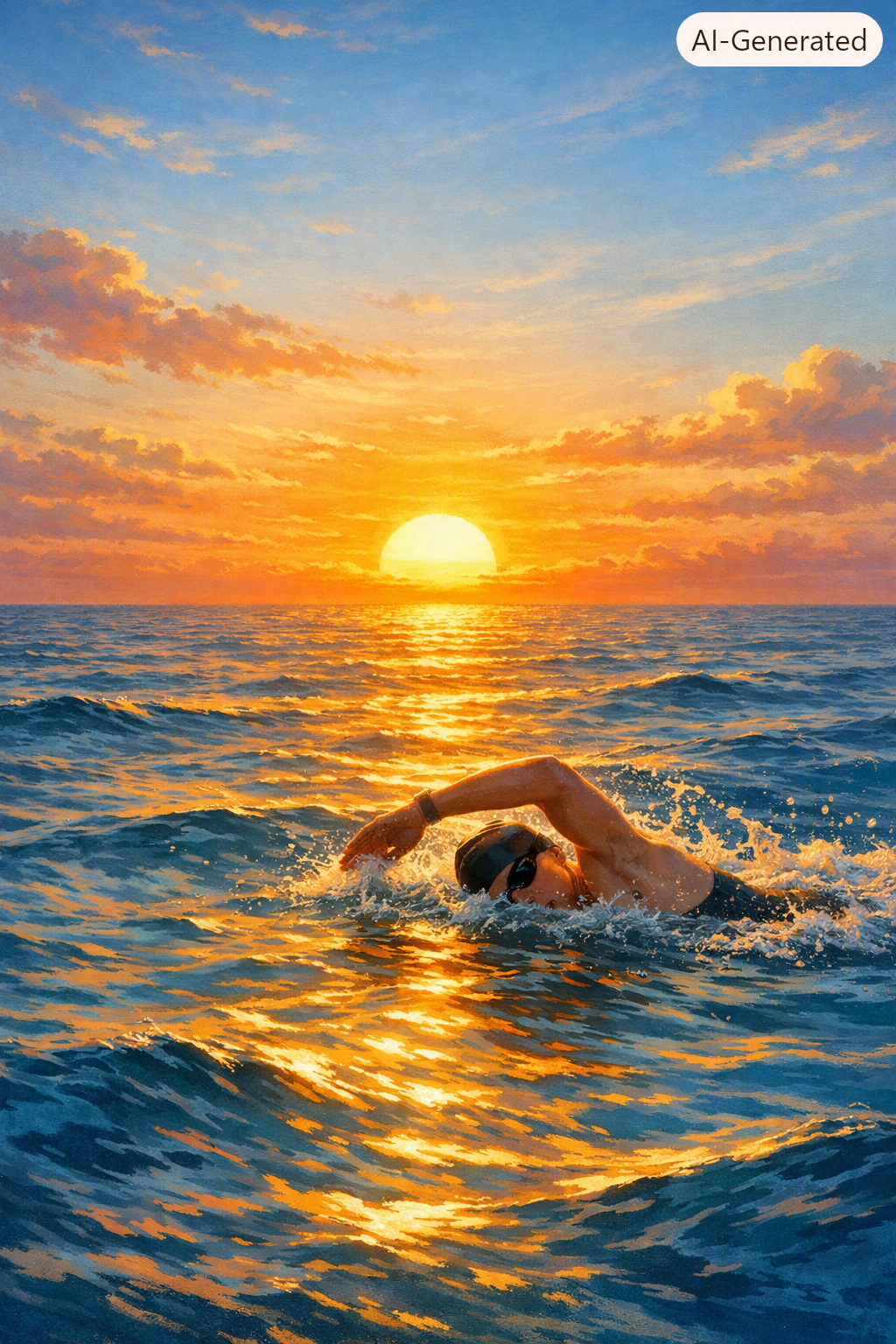
Swimming loads the shoulder girdle, the back, the trunk and the neck, and the legs to a lesser degree. It is close to being the only widely practised form of aerobic exercise in which forward movement is produced by the upper body.
Safety technique from the standpoint of the skeleton and muscles.
- Do not lift the headThe average head weighs about 5 kg. Swimming with the head raised means holding those five kilograms on a hyperextended neck hundreds of times in a row. In a study of front crawl in masters swimmers (2023), the swimmers who kept the head extended reported neck pain. To relieve neck strain, use goggles, look forward and down, and breathe by rotating the head together with the trunk rather than by lifting it.
- Do not hold your breathExhale into the water, calmly and completely. Breath holding raises intrathoracic pressure and increases tension in the muscles of the neck and shoulder girdle. And hyperventilating before a breath-hold dive is also a direct risk of losing consciousness underwater.
- Do not carry the arm across the midlineA stroke in which the hand is brought towards the opposite shoulder places the shoulder in flexion with internal rotation, that is, in the impingement position. Shoulder pain is the most common complaint among swimmers; in competitive swimmers its prevalence is estimated in the range of 27 to 87 percent.
- Breaststroke needs attention in two placesLower back: lifting the head and chest to breathe happens through hyperextension, and with a weak trunk this irritates the facet joints. Knee: the leg kick loads the medial compartment of the knee joint. With knee osteoarthritis and meniscal damage, breaststroke is better avoided.
- BackstrokeOften the best choice for problems with the neck and shoulders, if there is room to swim in a straight line.
Technical swimming versus untechnical swimming
Technical swimming is unquestionably better: less drag, fewer superfluous movements, less risk of overloading the shoulder. But dog paddle and frog paddle also produce an effect: horizontal unloading of the spine, gentle mobilisation of the joints in a warm resistant medium, cardiovascular load, work for the shoulders and trunk. My view here is simple: for a person in pain, the choice between a crooked stroke and giving up swimming is not a choice. Swim. The single caveat concerns the neck: if the stroke involves keeping the head above water, breaks and neck stretching afterwards are needed.
04Training in water
Water is a ready-made training machine with adjustable load, and the physics here works in four directions at once.
Buoyancy. Weight bearing at waist-deep immersion is about 50 percent of body weight, at chest depth about 30 percent, and at neck depth about 10 percent. Direct measurements with instrumented implants showed that during the same movements, forces in the hip and knee joint are 36 to 55 percent lower in water than on land.
Weight bearing by depth of immersion
Direct measurements with instrumented implants: hip and knee joint forces are 36–55% lower in water. But with fast movements and resistance devices they rise by up to 59% and reach 301% of body weight.
At the same time, however, with fast movements and additional resistance devices, joint forces increased by up to 59 percent and reached 301 percent of body weight. Water does not make the load light automatically. The load is governed by the speed of movement.
Resistance. It increases in proportion to the square of speed and acts in both directions. Raising the leg to the side works the abductor group; on the return, the adductor group. The antagonist muscle does not rest. The other side: there is almost no eccentric phase in water. This is an advantage in terms of delayed muscle soreness and microtrauma, and a disadvantage in terms of tendon adaptation.
Hydrostatic pressure assists venous return and reduces swelling in the limbs.
The warmth of the water reduces muscle tone.
Stretching in water. Warm water lowers tone, buoyancy supports the limb, pain is felt less, and the range that can be reached is greater than on land. Precisely for that reason it is easy to overstretch in water: pain feedback is muted. The rule: hold the position for five breathing cycles (one breathing cycle = inhale + exhale), with no bouncing movements and no chasing the maximum.
Strength work standing chest-deep in water
- straight leg raises forward and to the side with control of the pelvis;
- squats, slowly down and slowly up;
- trunk rotations with the palms held edge-on for resistance;
- “cycling” at the wall or floating, for the abdominal muscles;
- bringing straight arms together and apart with open palms, for the shoulder girdle and the scapular stabilisers.
Comparison with training on land. A meta-analysis of eight randomised trials, 579 patients with knee osteoarthritis, found no significant difference between aquatic and land-based training, neither in the short term nor in the long term.
Hence the practical conclusion. For a person in pain and for a deconditioned person, water is preferable as a point of entry: the threshold for starting to move is lower, the fear of pain is smaller, and the sensation of body weight is reduced.
This does not cancel training on land, since many movements cannot be performed in water. But it makes water training invaluable.
05Yoga nidra on hot sand
Yoga nidra is not an exercise but a protocol of directed attention in stillness. On the beach it gains a physical advantage that it does not have on a mat: sand takes the shape of the body.
Rolls are formed from sand and placed under the areas that cannot relax in a lying position:
- a low roll under the lumbar lordosis, so that the lower back is not left hanging in the air;
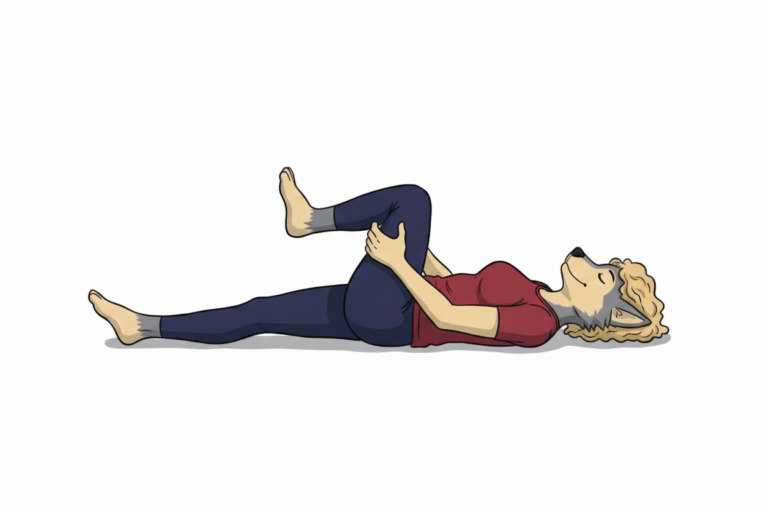
- a larger roll under the knees, which releases the pull of the iliopsoas and unloads the lower back;
- a thin roll under the cervical lordosis, so that the head rests rather than tips back.
A towel or a layer of warm sand on top. From there the same combination of factors works: even pressure, warmth, the horizontal position and the absence of demands on attention. For a patient with chronic pain and high baseline tone this is often more useful than another set of exercises.
Hold the position for 15 to 25 minutes, the head must be in the shade, and do not forget to drink water beforehand and to set an alarm so as not to fall asleep in the sun.
06Safety rules
Limits and contraindications
- Solar intensity. Prolonged time in the sun is advisable before 10 and after 16 hours.
- Overheating. Sand wraps raise body temperature, which is contraindicated in cardiovascular disease and in pregnancy.
- Diabetic neuropathy. With impaired sensation in the skin of the feet, walking barefoot, and all the more so on hot sand, is contraindicated.
- Full immersion increases central blood volume and cardiac preload, which matters in heart failure.
- Acute inflammation, fresh injury, fever, open wounds and skin infections – a contraindication to bathing and to contact with hot sand.
Sources
- Lejeune T.M., Willems P.A., Heglund N.C. Mechanics and energetics of human locomotion on sand. J Exp Biol. 1998;201(13):2071–2080. pubmed.ncbi.nlm.nih.gov/9622579
- Hot sand baths (psammotherapy): A systematic review. Complementary Therapies in Medicine. 2018. sciencedirect.com/science/article/abs/pii/S0965229918309695
- Effect of training in a sandy environment on foot morphology and function. 2024. pubmed.ncbi.nlm.nih.gov/39593505
- Ekholm B., Spulber S., Adler M. A randomized controlled study of weighted chain blankets for insomnia in psychiatric disorders. J Clin Sleep Med. 2020. aasm.org/study-shows-weighted-blankets-can-decrease-insomnia-severity
- Shoulder and Neck Pain in Swimmers: Front Crawl Stroke Analysis. 2023. ncbi.nlm.nih.gov/pmc/articles/PMC10572881
- Does aquatic exercise reduce hip and knee joint loading? In vivo load measurements with instrumented implants. PLoS One. 2017. ncbi.nlm.nih.gov/pmc/articles/PMC5358747
- Is aquatic exercise more effective than land-based exercise for knee osteoarthritis? Meta-analysis. Medicine. 2018. pubmed.ncbi.nlm.nih.gov/30593178
- Exercise for people with hip or knee osteoarthritis: a comparison of land-based and aquatic interventions. Open Access J Sports Med. tandfonline.com/doi/full/10.2147/oajsm.s6941