Talk to your pain
Talk to your pain
Why avoiding movement makes pain stronger, and what to do instead.
A familiar picture, a person with a painful lower back avoids bending. Either they lower themselves into a squat, holding the spine straight as a board, or they simply ask for help. In this way the muscles already in spasm go into deeper spasm, and the weak ones grow weaker still.
The body speaks to us through pain. But we hear it wrongly. Pain points to the muscle that needs our attention, and this signal must never be taken as advice to stop moving. Only one kind of pain truly calls for immobilisation – acute traumatic pain. Not chronic pain in the back and the joints.
A muscle that is not stretched by natural movement begins to shorten. A muscle that is no longer loaded grows weak. A joint that is not used through its full range grows adhesions inside. And the load that ten muscles used to carry now falls on three. Those three go into spasm. A muscle in spasm hurts. We answer the pain with more avoidance. The circle of pain has closed.
Remember: spasm and weakness always come in pairs
The idea that a muscle in spasm needs stretching is clear enough and logical. And experience does show that stretching works. So why does the pain come back again? How do we end up in a closed circle of chronic overload of the very same muscle?
Most often the answer is one. Its partner on the other side of the joint is not working.
Every joint has a pair of antagonist muscles. A flexor and an extensor. One pulls forward, the other back, and between them there is a treaty of balance. The nervous system is built so that when one muscle switches on, the other receives the command to relax. This is called reciprocal inhibition, and it is a very logical mechanism: you cannot bend and straighten the arm at the same time, the nervous system will not allow it.
But if one muscle is in constant tension, its antagonist receives a constant signal to switch off. And that muscle grows weak. And as it weakens, it stops holding the joint from its own side, and the first muscle is forced to work for two. It tightens even further. And switches its partner off even further.
Add to this the pain inside the joint itself. When there is swelling or inflammation in the knee, receptors in the capsule send a signal to the spinal cord that inhibits the quadriceps. This is called arthrogenic muscle inhibition: the joint literally switches off its own main muscle, trying to immobilise and protect itself. A protection that is sensible for three days and destructive over three months.
The three most common complaints
Pain in the lower back on bending
Bending must never be avoided! On the contrary, start looking for reasons to bend in your everyday routine. Do it consciously, keeping your attention on the muscles of the back.

How to bend
- Feet hip width apart. in breath
- out breath On a slow exhale begin to lower yourself, vertebra by vertebra, from the top down, the head heavy, the arms hanging.
- Knees soft, slightly bent.
- Keep your attention not on the floor but on the lower back: feel how it unfolds and lengthens.
- At the bottom stay for two calm breaths.
- in breath Come up just as slowly, from the bottom up, the lower back switching on last.
- take a pot out of a low cupboard
- take the laundry out of the machine
- pick up what you dropped
- make the bed
- stroke the dog
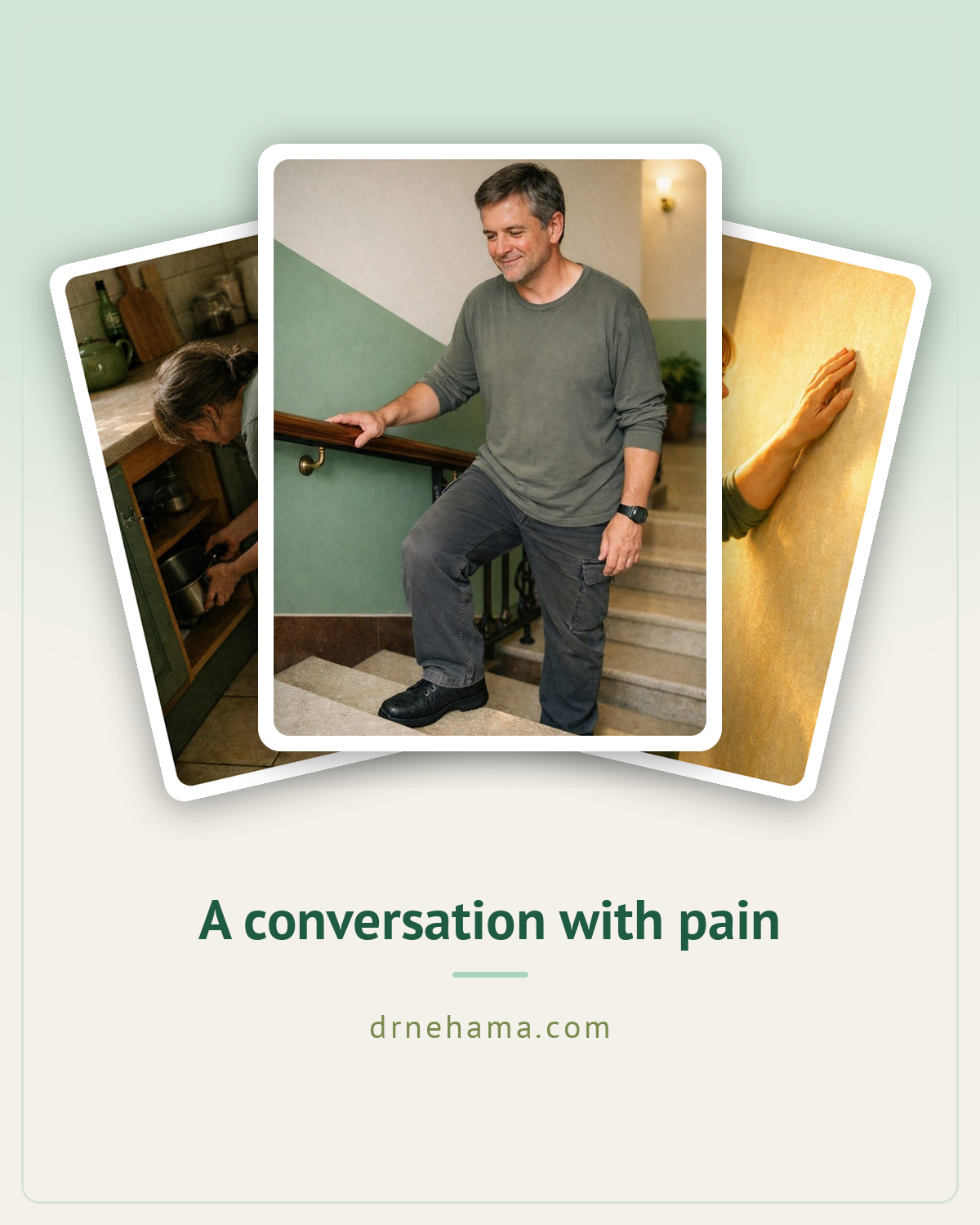
Pain in the knees going up and down stairs
The lift is a convenience that costs us the quadriceps. A weak quadriceps stops absorbing the impact of every step, and the whole shock wave travels straight into the knee cartilage.

How to go up
- Place the whole foot on the step, not the toes.
- Work not with the knee but with the buttock and the hip: imagine you are pushing your body upward with the heel of the supporting leg.
- The knee points straight ahead and does not fall inward.
- Hold the handrail lightly, for balance.
How to come down
- Slowly, placing the foot softly, bending the knee of the supporting leg a little and letting the thigh work as a shock absorber.
- out breath as the knee bends, in breath as the weight transfers onto the straightened leg.
- If it hurts, come down step by step, placing both feet on each stair, and hold on.
Pain in the shoulder on raising the arm
Here the price of avoidance is the highest, a frozen shoulder forms within a matter of days. The capsule of the joint contracts, and within a few weeks the arm no longer rises, not because of pain but physically.

How to raise the arm
- Stand side on to the wall. in breath
- out breath On the exhale lead the arm slowly up the wall, helping with the fingers, as if walking along it. The elbow is soft.
- Go to the point where the first tension appears and stop there, without going into pain. Two calm breaths.
- out breath On the exhale try to add a centimetre. On the next exhale another centimetre.
- Hold the position for 5 breathing cycles (in breath + out breath = one cycle).
- in breath On the in breath slowly return the arm to the starting position.
- reach for cups on the top shelf
- hang clothes on hangers
- wash a window
- brush your teeth by lifting the elbow instead of bending to the sink
Kinesiological chains
Muscles do not work alone. They are gathered into long chains running through the whole body: from the sole through the calf, the back of the thigh, the lower back, the back, all the way to the base of the skull. Pull one end and the other answers.
That is why the lower back sometimes hurts because the calf muscle has shortened. And the shoulder does not rise because the thoracic spine does not rotate. The body cannot be treated in parts, the way a washing machine is repaired, everything in it is connected.
I like to tell the story of a patient who suffered for years from headaches that no one could explain and no one could treat. A careful examination revealed a shortened Achilles tendon. Stretching and a fitted insole solved the problem.
But how could anyone have guessed that the heel would turn out to be the culprit behind the headache?