Matot-Masei
Weekly Portion
Matot-Masei
מַטּוֹת-מַסְעֵי
Numbers 30:2-36:13
The Story
These two portions conclude the Book of Numbers. Matot opens with the laws of vows: a word spoken aloud acquires the force of law. Then comes the war against Midian and the division of the spoils. The tribes of Reuben and Gad ask Moses to let them settle on the eastern bank of the Jordan, where the pastures are good, and Moses agrees on one condition: first they will go with their brothers to conquer the Land, and only then return to their flocks. Masei lists all forty-two journeys of the people through the wilderness, from Egypt to the plains of Moab, defines the borders of the Land of Israel, and establishes six cities of refuge for one who kills unintentionally.
Commentary · Rashi
Rashi on Numbers 33:1 asks: why does the Torah list every encampment? He brings a parable from the Midrash: a king carried his sick son to a distant land to be healed, and on the way home, with the boy already well, he stopped at each place and remembered: here we slept, here we were cold, here your head ached. So the Almighty recounts to Israel the stations of the wilderness, like a father lovingly turning the difficult pages of a journey that is already behind them.
He shall not break his word; all that comes out of his mouth he shall doNumbers 30:3
Commentary · Ramban
Ramban (Numbers 33:53) reads the words ‘and you shall take possession of the land and dwell in it’ not as a promise but as a commandment binding in every generation. That is why the Torah traces the borders of the Land with such care, from the River of Egypt to Mount Hor: an inheritance is never abstract. Love for a home begins when the home has walls and an outline: what is not delineated can be neither guarded nor passed on to one’s children. For Ramban, borders are not about shutting others out, they are about knowing exactly what has been entrusted to you to keep.
Two Maps of One Land
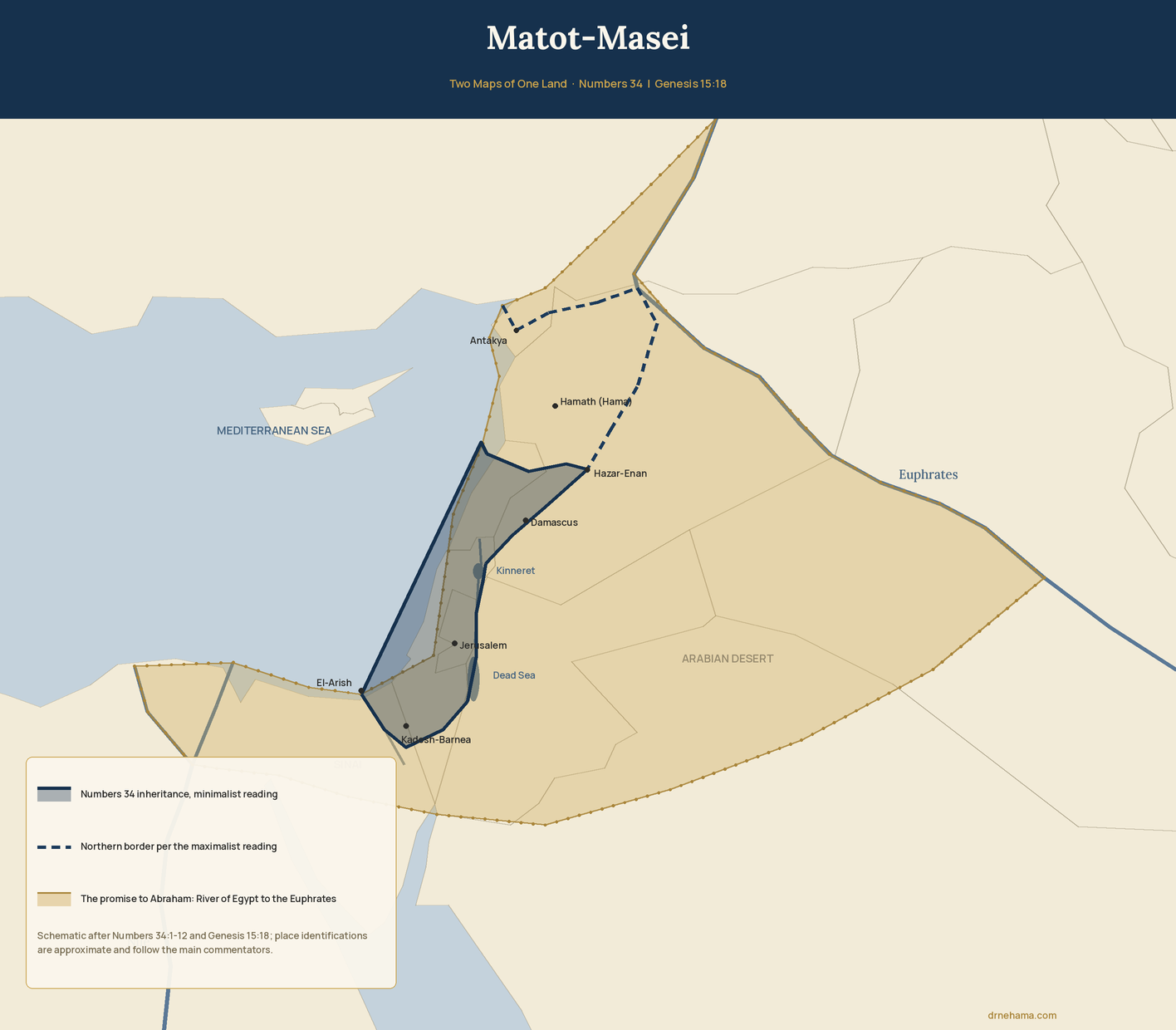
When the Torah speaks of the borders of the Land of Israel, it draws not one map but two.
The first map: the commanded inheritance. In our portion (Numbers 34:1-12) the Almighty traces the borders of the land the people must inherit and settle. South: from the edge of the Dead Sea through the wilderness of Zin, south of Kadesh-Barnea, to the River of Egypt. Most commentators, following Targum Yonatan, identify this stream with Wadi el-Arish in northern Sinai; Saadia Gaon read it as a branch of the Nile. West: the Great Sea, the Mediterranean. East: from the environs of Damascus down along the eastern shore of the Kinneret, then along the Jordan to the Dead Sea.
The dispute begins in the north, at the mysterious Mount Hor (Numbers 34:7, not the mountain where Aaron died). The minimalist reading, held by most Rishonim in their commentaries on the verse, places it in the mountains of present-day Lebanon: the inheritance then includes today’s Israel with the Golan, Lebanon, and a strip of western Syria. The maximalist reading, set out in greatest detail by Rabbi Eshtori HaParchi in Kaftor VaFerach (14th century), moves Mount Hor to the Amanus range in southern Turkey: the northern border then runs near Antakya, and all of western Syria falls within the inheritance.
Curiously, Transjordan, the inheritance of Reuben, Gad, and half of Menashe, is not included in the borders of Numbers 34 at all. Their separate bank lay literally beyond the border, and acquired holiness only because it was conquered and annexed (Ramban on Numbers 21:21 discusses the special status of these lands).
The second map: the promise to Abraham. Long before the borders of Numbers, the Almighty promised Abraham the land from the River of Egypt to the great river, the river Euphrates (Genesis 15:18), listing the lands of ten nations, including the Kenites, Kenizzites, and Kadmonites. This outline is incomparably wider. In modern geography it covers all of present-day Israel, Lebanon, Syria, Jordan, the Sinai Peninsula up to the Nile or to El-Arish (depending on how the River of Egypt is read), and in the northeast reaches the Euphrates, taking in western Iraq and, by some readings, northern Saudi Arabia and southeastern Turkey, where the Euphrates rises. Tradition separates the two maps in time: the inheritance of Numbers 34 is the boundary of the practical commandment of settlement for the generations, while the promise to Abraham belongs to the future, to the days of complete redemption. The Midrash (Bereshit Rabbah 44:23) says explicitly that the lands of three of the ten nations will be given to Israel only in the time to come.
So there you have it: from the river to the sea, in its original connotation.
Takeaway
Mama Nehama’s takeaway
In this portion we learn a very important lesson about family. When the tribes of Reuben and Gad asked for an inheritance on the other bank of the Jordan, Moses did not tell them no. He said: go your own way, but first walk the common road to its end. This is the whole wisdom of family: each of us may and must have our own portion, our own dream and our own destiny; this is what today is called separation, a normal and healthy process of growing up. But in a moment of trial or of special joy, the family gathers into a single being. I am for you, and no one is more for you than me: that is my main motto toward my loved ones. Even if I disagree with you, you will hear about it in private. But if you need to be defended, I will stand up for you against the whole world. Family does not dissolve a person; it gives him a point of support from which one can and should set out on one’s own path, and to which it is always safe to return. We have enough enemies outside. Family must be a safe zone that guarantees support.
Three questions
Answer three questions and receive the quote that will shape your week
All three done. Open your quote for the week.
Your week