Pinchas
Weekly Portion
Pinchas
פינחס
Numbers 25:10-30:1
The Story
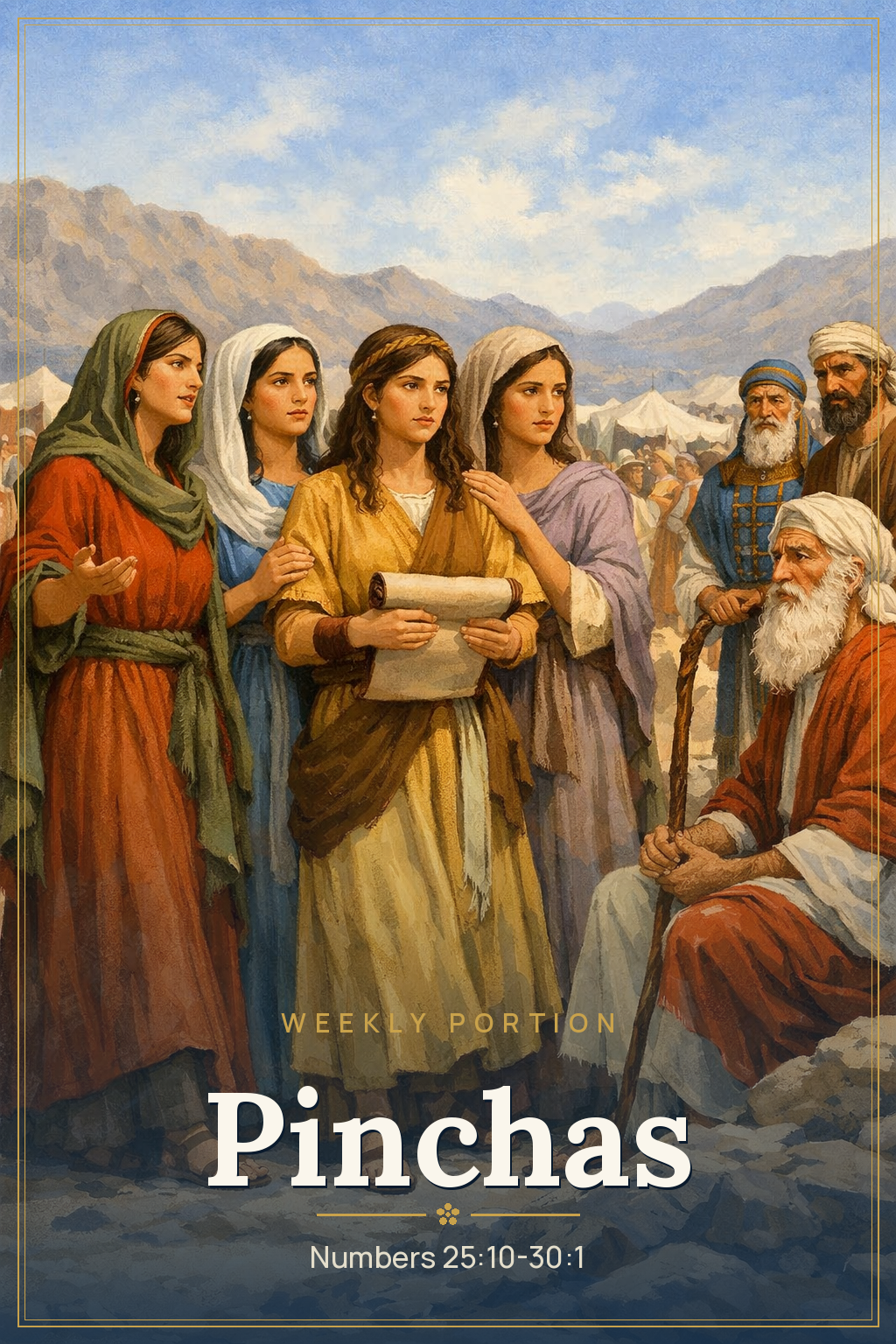
The portion opens with Pinchas’s reward. At the close of the previous portion he halted the plague that struck the people for their harlotry with the women of Moav and the worship of Baal Peor, running a single spear through Zimri and the Midianite woman Cozbi. Now God announces that He grants Pinchas a covenant of peace and an eternal priesthood, for him and for his descendants. Then the people are counted again before entering the Land, tribe by tribe, since the shares of land will be divided according to the families. It is here, amid the talk of inheritance, that five sisters step forward, the daughters of Zelophehad: Machlah, Noa, Choglah, Milkah and Tirzah. Their father died leaving no sons, and by the law as it then stood his portion did not pass to daughters, so his name would vanish from the roll of those who held the Land. The sisters come before Moshe, before Elazar the High Priest, before the chieftains and the whole community at the entrance of the Tent, and ask for a share in their father’s inheritance. Moshe does not decide alone. He brings their case before God, and the answer comes: the daughters speak rightly, their father’s portion passes to them, and from this a general law of inheritance is drawn for all Israel. God then tells Moshe to ascend Mount Avarim, to see the Land from afar and prepare to be gathered to his people, and in answer to Moshe’s request for a shepherd for the community, Joshua son of Nun is appointed, and Moshe lays his hands upon him before all. The portion closes with the detailed order of the public offerings, of every day, of the Sabbath, of the new moon and of the festivals, that very rhythm which holds the life of the people day after day.
Commentary · Pinchas’s act
Tradition does not read Pinchas’s act as a simple triumph of righteous anger. The Talmud in tractate Sanhedrin says something startling: the law is that a zealot may strike, and yet, such is the law, but we do not instruct so. Had Pinchas come to the court and asked permission beforehand, he would have been refused. The Torah acknowledges his impulse, but it refuses to turn that impulse into an instruction or a model to be repeated. The reward itself says the same thing. In the Torah scroll the letter vav in the word shalom, in the covenant of peace, is written broken, shortened, and many commentators read this as a sign: even a justified act of violence leaves a crack, and the peace that follows it is incomplete. The Netziv, in Haamek Davar, explains it more subtly still. Precisely because such a deed can harden the soul and bend a person toward violence, God grants Pinchas peace as an antidote, so that zeal should not burn the human being out of him. Pinchas’s reward, then, is not applause for the sword. It is a care that a living soul should not be lost in a single moment of zeal.
Commentary · The daughters of Zelophehad
The daughters of Zelophehad do not rebel and do not break the law. They step inside the law and say: here is a gap, carry the line of justice through to its end. And something very rare happens. God answers not merely give it to them, but the daughters of Zelophehad speak rightly. Rashi brings the midrash that this law was already written above, and the sisters merited that it should enter the world through them, because their eye saw what others did not. The Torah gives their names in full, and more than once, in a place where women usually remain in the shadow of the genealogies. The sages in tractate Bava Batra call them wise, learned in Torah and righteous, for they came not for themselves but for their father’s honour and for the wholeness of the law. Here the Torah shows that a woman’s voice is not an appendix to the system but a full part of it, and that a justice with no place for a daughter is not yet complete.
The daughters of Zelophehad speak rightlyNumbers 27:7
Takeaway
Mama Nehama’s takeaway
1. This is one of the most feminist portions in the Torah, and it shows what real equality means. From the daughters of Zelophehad we learn that a frame can be seen in two ways. For one person a frame is a limit, a wall not to be crossed. For another it is a scaffold, a support to stand on and reach higher. The daughters of Zelophehad did not break the frame of the law. They leaned on it and widened it from within, and the Torah answered them: rightly.
2. I consider Yigal Amir to be the Pinchas of our time. Just like Pinchas, he deeply loves his people and is ready to do anything for them. Just like Pinchas, he cannot tolerate the betrayal of his people. Just like Pinchas, having failed to achieve his goal by peaceful means, he resorts to extreme measures to save his people from the impending disaster. We know that the Almighty approved and justified the actions of Pinchas. And I hope that soon we will be able to see that human justice is powerless before the just Supreme Court and to see Yigal free, together with his family.
Three questions
Answer three questions and receive the quote that will shape your week
All three done. Open your quote for the week.
Your week